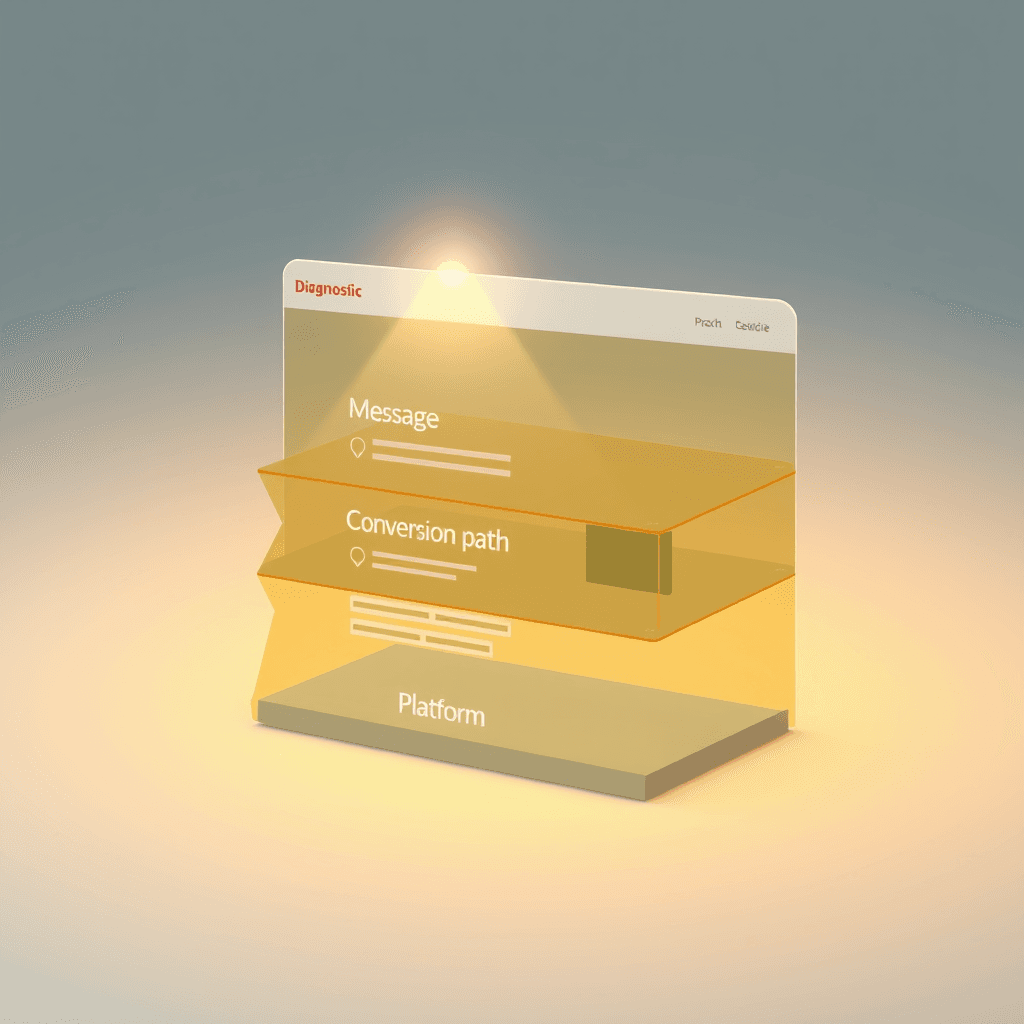
"We need a new website." It's one of the most common requests we hear, and it's almost never the real problem. A website is three systems stacked on top of each other, and only one of them is the thing most people mean when they say "rebuild." Spend money on the wrong layer and you'll land in the same place twelve months later, lighter in the bank and no better at generating leads.
Before you approve a redesign budget, it's worth spending a week figuring out which layer is actually failing.
The Three Layers Underneath Your Site
The message. What you sell, who it's for, what it costs you to not have it, and why someone should believe you. This lives in copy, proof, and positioning.
The conversion path. The sequence a visitor walks: landing page, what they read, what they click, what you ask them for, what happens after they submit. This lives in page structure, forms, and follow-up.
The platform. The code, CMS, hosting, and integrations that deliver all of it. This is what a rebuild actually replaces.
A redesign fixes the third layer and shuffles the first two. If your message is unclear or your conversion path leaks, new code will render the same problems more attractively.
Diagnose Before You Demolish
Four checks, none of which require a vendor.
First, pull your top ten landing pages by traffic and look at where visitors go next. If most of them leave without touching a call to action, you have a message or path problem, not a platform problem. If they try to convert and something breaks — a form that errors, a page that loads blank on mobile — now you're looking at the platform.
Second, run your key pages through Google's PageSpeed Insights and look at field data, not lab scores. Google's published guidance treats Largest Contentful Paint at 2.5 seconds or less as good, with separate thresholds for interaction responsiveness and layout shift. Lab scores tell you what's theoretically possible on a fast connection; field data tells you what your actual buyers experienced. Fix what real users feel.
Third, try to make a small change yourself. Update a headline, add a testimonial, publish a case study. If that takes a developer ticket and a two-week wait, your platform is throttling your marketing regardless of how it looks. That's a genuine rebuild argument.
Fourth, follow a lead from form submission to your CRM or ERP. If someone is copying entries from an inbox into a spreadsheet, the website isn't your bottleneck — the gap between it and your operating systems is.
When a Rebuild Is Genuinely the Right Call
There are real triggers. A rebuild earns its budget when:
- Your team can't publish or edit without engineering help
- The platform or plugins are unsupported, creating a security exposure you can't patch
- Mobile experience is structurally broken rather than cosmetically dated
- The site can't connect to your CRM, ERP, or payment systems through anything resembling an API
- Every new page requires custom work because there are no reusable templates
Notice what isn't on that list: "it looks dated." Dated and ineffective are different diagnoses. Plenty of plain sites convert well because the message is sharp and the path is short.
The Cost Nobody Prices In
A full rebuild carries hidden costs that rarely appear in the proposal. You pause content and campaign work during the build. You risk URL changes that drop rankings you spent years earning. You reset the analytics baseline you'd need to prove whether the new site performed better. And you often rebuild pages nobody visits, because the inventory wasn't audited first.
If you do rebuild, budget for a redirect map, a pre-launch crawl, and a measurement plan that carries forward. These are cheap compared to recovering lost organic traffic.
The Middle Path Most People Skip
You don't have to choose between "change nothing" and "replace everything." The approach we use most often is incremental replacement: rebuild the highest-value templates first — the pages that drive revenue — on a modern foundation, leave the rest in place, and migrate as each section earns its turn.
That gets you a fast, editable, integrated page for your core offer in weeks instead of quarters. You learn whether the new approach actually converts before committing the full budget. And your marketing never goes dark during a six-month freeze.
Where to Start This Week
List your top ten pages. For each one, write down the single action you want a visitor to take, then check whether the page makes that action obvious within the first screen. Pull field performance data. Try to publish something yourself and time it.
By the end of that exercise you'll know whether you need a copywriter, a conversion review, a developer, or a new foundation — and you'll be a far better buyer of whichever one you need.
If you'd like a second opinion on which layer is actually costing you leads, reach out. We'll look at the same evidence with you and tell you honestly whether a rebuild is warranted or whether your money belongs somewhere else.